多路搜尋樹與 B-Tree
My vault 資料結構筆記:多路搜尋樹與 B-Tree。
M-Way Search
定義
M-way Search Tree(M ≫ 2)重點
-
主要用於 external search:資料量大,節點通常存於外部儲存(如磁碟),存取以 I/O 次數為主。
-
一個節點的 degree 介於 $0$ 與 $m$。
-
若節點的 degree 為 $m$,則該節點內的 keys 數為 $(m-1)$。
-
同一節點內的 keys 以 遞增排序。
-
search/insert/delete x的時間為 $O(h)$,其中 $h$ 是樹高;若結構 skewed,實際效能最壞也取決於 $h$。
定理(高度為 $h$ 的 $m$-way search tree)
-
節點數上界: $\sum_{i=1}{h} (m{i-1}) ,=, \frac{m^{h}-1}{m-1}$
-
Key 上界: $m^{h}-1$
直觀:每層最多有 $m^{i-1}$ 個節點;每節點最多含 $(m-1)$ 個鍵,故總鍵數最多為 $(m-1)\cdot\frac{m^{h}-1}{m-1}=m^{h}-1$。
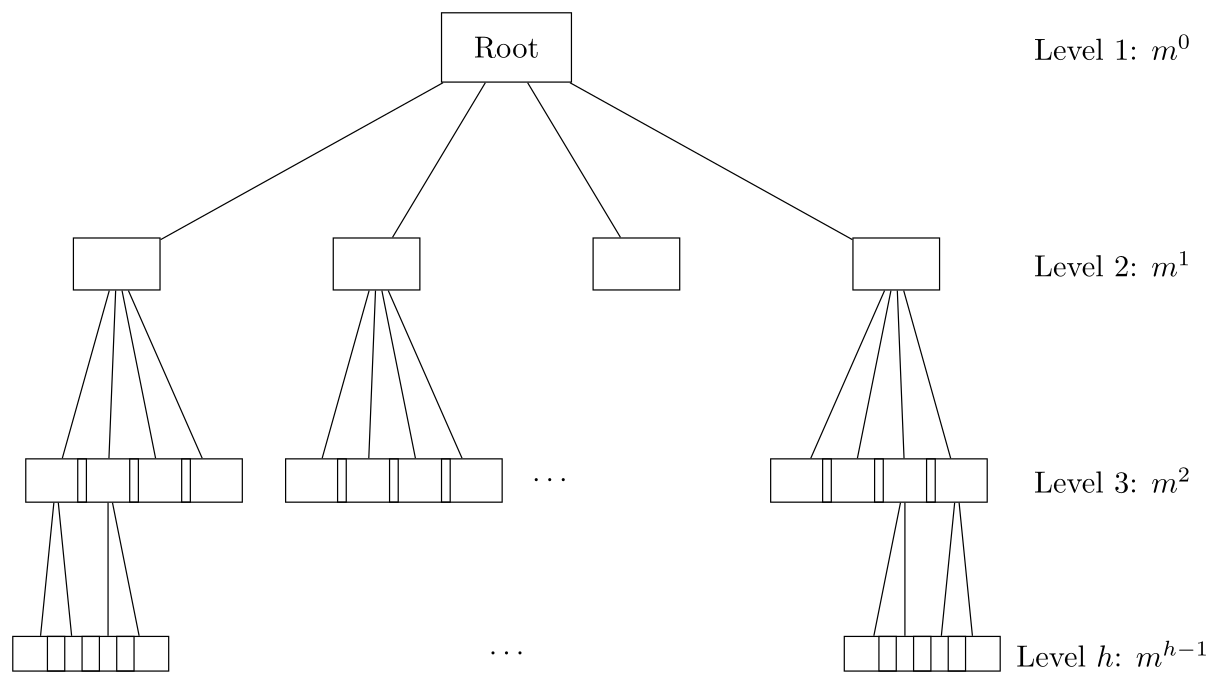
下例:degree = 4,keys = 3;根鍵為 5 | 30 | 46,四個子節點分別承接區間 <5、[5,30)、[30,46)、≥46。

設定
-
root level = 1。
-
每個節點最多 $m$ 個 children、至多 $(m-1)$ 個 keys。
-
高度 $h$(共有 $h$ 層)。
(A) 最多節點數
第 $i$ 層(從 1 起算)最多節點數:$m^{i-1}$.
總節點:
$$\sum_{i=1}{h} m{i-1} = 1 + m + m2 + \cdots + m{h-1} = \frac{m^{h}-1}{m-1}.$$
(B) 最多鍵數
每節點最多 $(m-1)$ keys,故:
$$\bigg(\frac{m^{h}-1}{m-1}\bigg)\cdot(m-1) = m^{h}-1.$$
板書對照:右側的兩個 boxed 結果分別是 $\dfrac{m^{h}-1}{m-1}$(節點)、$m^{h}-1$(keys)。
左側樹形圖:每層的最大節點計數為 $m0, m1, m2, \dots, m{h-1}$。
B Tree of Order M
定義 (Definition)
B-Tree of order m 是一種 balanced m-way search tree,主要應用於外部搜尋 (external search) 與外部排序 (external sort)。若非空,需滿足以下條件:
-
根節點 (root) 的 degree: $2 \leq \deg(\text{root}) \leq m$
-
除根以外的內部節點 (internal nodes) 的 degree: $\left\lceil \tfrac{m}{2} \right\rceil \leq \deg(\text{node}) \leq m$
-
所有葉節點 (leaf nodes) 必須位於同一層,確保樹保持平衡。
定理 (Theorem)
對於高度為 $h$ 的 m-way search tree (root level = 1):
-
Maximum number of nodes $N_{max}=\sum_{i=1}h m{i-1} = \frac{m^h - 1}{m - 1}$
-
Maximum number of keys $K_{max} = m^h - 1$
-
Minimum number of nodes $N_{\min} = 1 + 2 \cdot \frac{\left(\left\lceil \tfrac{m}{2} \right\rceil^{h-1} - 1 \right)}{\left\lceil \tfrac{m}{2} \right\rceil - 1}$
-
Minimum number of keys $K_{\min} = 2 \cdot \left\lceil \tfrac{m}{2} \right\rceil^{h-1} - 1$
-
最少 keys: $K_{\min}=2,t^{,h-1}-1=2\cdot\left\lceil\frac{m}{2}\right\rceil^{h-1}-1$
- 例如 $m=3$: $K_{\min}=2\cdot\left\lceil\tfrac{3}{2}\right\rceil^{h-1}-1=2\cdot 2^{h-1}-1=2^{h}-1$
-
證明
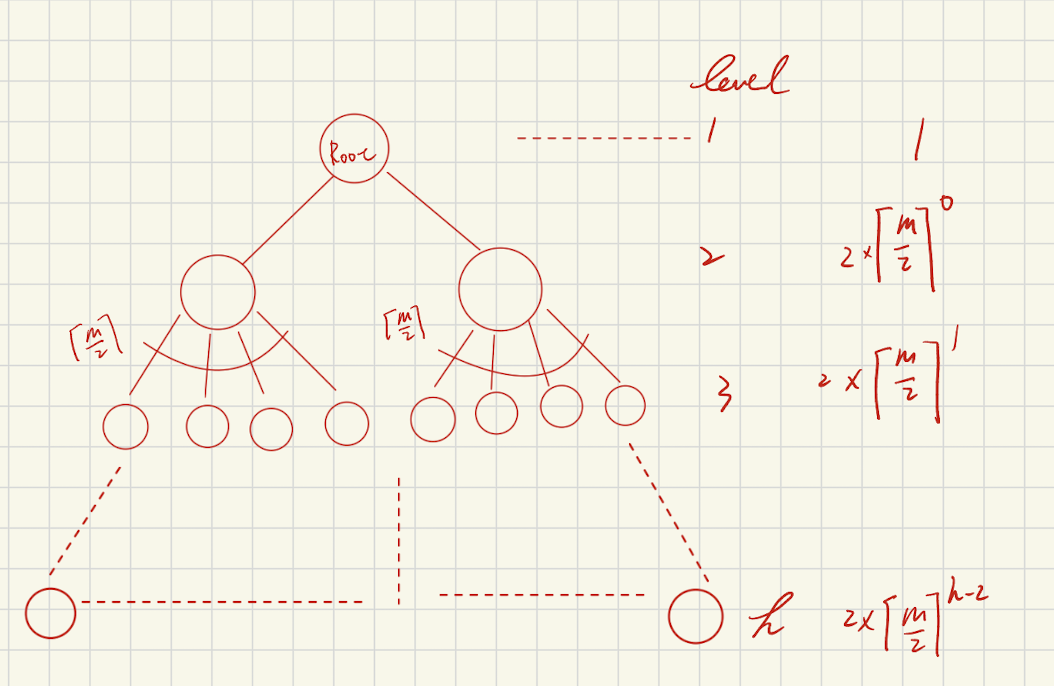
最少 nodes(包含葉)
層別節點數(root 取 degree = 2,其餘皆取 $\lceil m/2\rceil$):
$$
#\text{level}_1=1,\quad #\text{level}_2=2,\quad #\text{level}_k=2\Big\lceil \frac{m}{2}\Big\rceil^{,k-2};(k\ge2).
$$
因此
$$
\begin{aligned}
N_{\min}(h)
&=1+\sum_{k=2}{h}2\Big\lceil \frac{m}{2}\Big\rceil{k-2}
=1+2\sum_{i=0}{h-2}\Big\lceil \frac{m}{2}\Big\rceil{i}
=1+2,\frac{\Big\lceil \tfrac{m}{2}\Big\rceil^{h-1}-1}{\Big\lceil \tfrac{m}{2}\Big\rceil-1},.
\end{aligned}
$$
最少 keys
-
非根每個節點的最少 keys,簡單來說就是你會需要 3 個 $key$ 切開 4 個子樹:$\left\lceil \frac{m}{2} \right\rceil-1$
-
最少「非根」節點數:$\Big[,2\cdot\frac{\left\lceil \tfrac{m}{2} \right\rceil^{,h-1}-1}{\left\lceil \tfrac{m}{2} \right\rceil-1},\Big]$(由最少 nodes:$1+2\cdot\dfrac{\left\lceil \tfrac{m}{2} \right\rceil^{h-1}-1}{\left\lceil \tfrac{m}{2} \right\rceil-1}$ 減去 root 得到)
因此最少 keys:
$$
\begin{aligned}
K_{\min}(h)
&=\underbrace{1}_{\text{root}}+\Big[,2\cdot\frac{\left\lceil \tfrac{m}{2} \right\rceil^{,h-1}-1}{\left\lceil \tfrac{m}{2} \right\rceil-1},\Big]\cdot\Big(\left\lceil \tfrac{m}{2} \right\rceil-1\Big)\[4pt]
&=1+2\Big(\left\lceil \tfrac{m}{2} \right\rceil^{,h-1}-1\Big)\[2pt]
&=2,\left\lceil \tfrac{m}{2} \right\rceil^{,h-1}-1,.
\end{aligned}
$$
備註
-
名稱「2-3 Tree」、「2-3-4 Tree」等,來自允許的 degree 範圍:
-
Order 3 → degree = 2, 3 → 2-3 Tree
-
Order 4 → degree = 2, 3, 4 → 2-3-4 Tree
-
Order 5 → degree = 3, 4, 5 (root 可為 2),不是 2-3-4-5 Tree
-
判斷有沒有此種樹
| order mm | 根的 degree | 非根節點 degree | 允許的節點型別(degree) | 常見名稱 | 是否存在 |
|---|---|---|---|---|---|
| 3 | 2–3 | 2–3 | 2, 3 | 2-3 Tree | ✓ |
| 4 | 2–4 | 2–4 | 2, 3, 4 | 2-3-4 Tree | ✓ |
| 5 | 2–5 | 3–5 | 3, 4, 5(根可 2) | order-5 B-Tree 或 3-4-5 Tree | ✗ 對「2-3-4-5」 |
說明:m=5m=5 時,非根下限為 $\lceil 5/2\rceil=3$。一般節點不能有 degree=2,因此**沒有「2-3-4-5 Tree」**這個名稱。
例:2-3 Tree 給定 key 數 n 求高度界
-
最小高度(最滿): $3^{h}-1\ge n;\Rightarrow; h=\left\lceil\log_{3}(n+1)\right\rceil$
-
最大高度(最稀): $2^{h}-1\ge n;\Rightarrow; h=\left\lceil\log_{2}(n+1)\right\rceil$
插入 X 到 B 樹 (Order M)
-
Step 1. Search for X 由於 $X$ 不在樹中,會找到一個 external node (null)。 將 $X$ 放入該 external node 的 parent。 (找到 $X$ 的位置,在 node 放入 $X$)
-
Step 2. Check the node
-
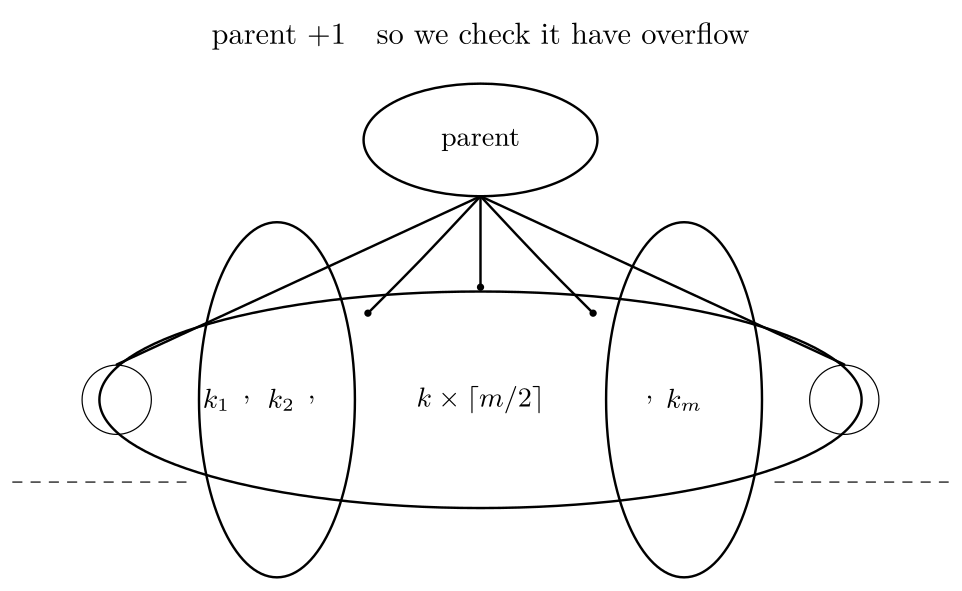
是否 overflow?key 數 $= m > m-1$?
-
如果 沒有 overflow → 結束。
-
如果 overflow → 做 split action,並且往上檢查 parent。
-
-
Split action
-
選出 $\lceil m/2 \rceil$ 的 key $k$
-
把 $k$ 移到 parent
-
其餘 key 分左右 child
-
Example
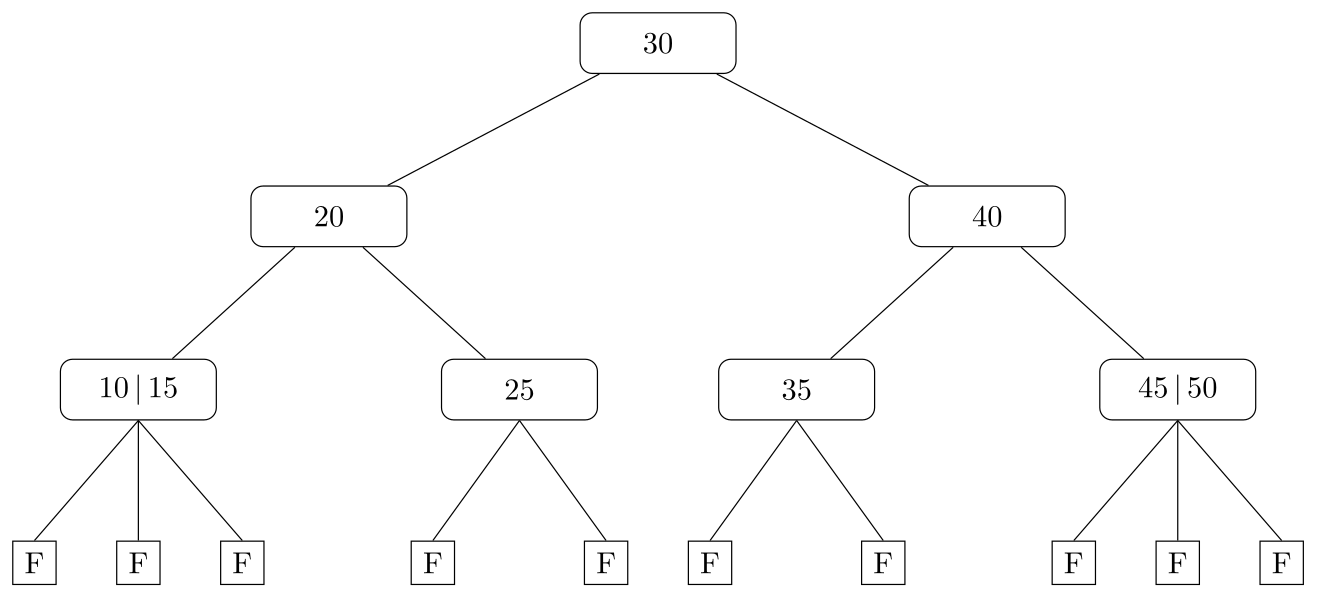
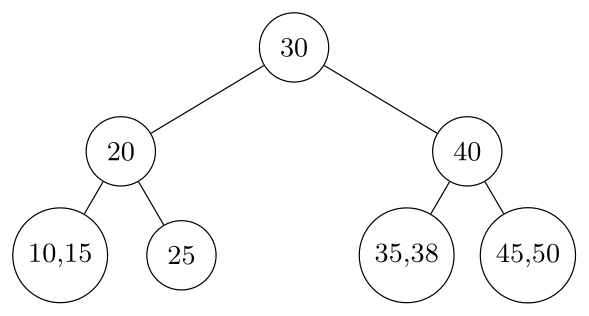
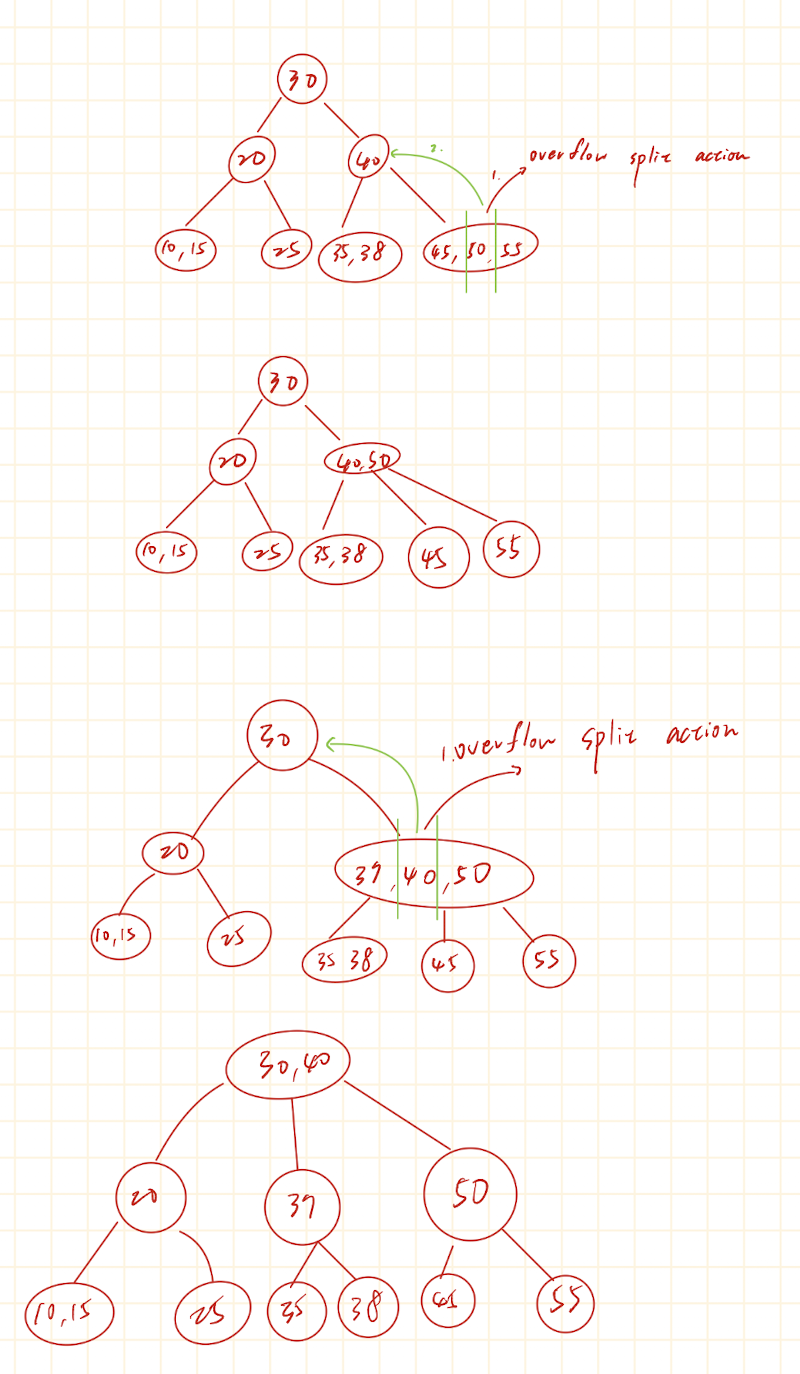
- B tree of order 3 (or 2-3 tree), what’s the result after insert 55, 37
- 插入 55,但是因為 overflow 最多只能 $\left\lceil \tfrac{m}{2} \right\rceil \leq \deg(\text{node}) \leq m=2$, 所以需要 split action
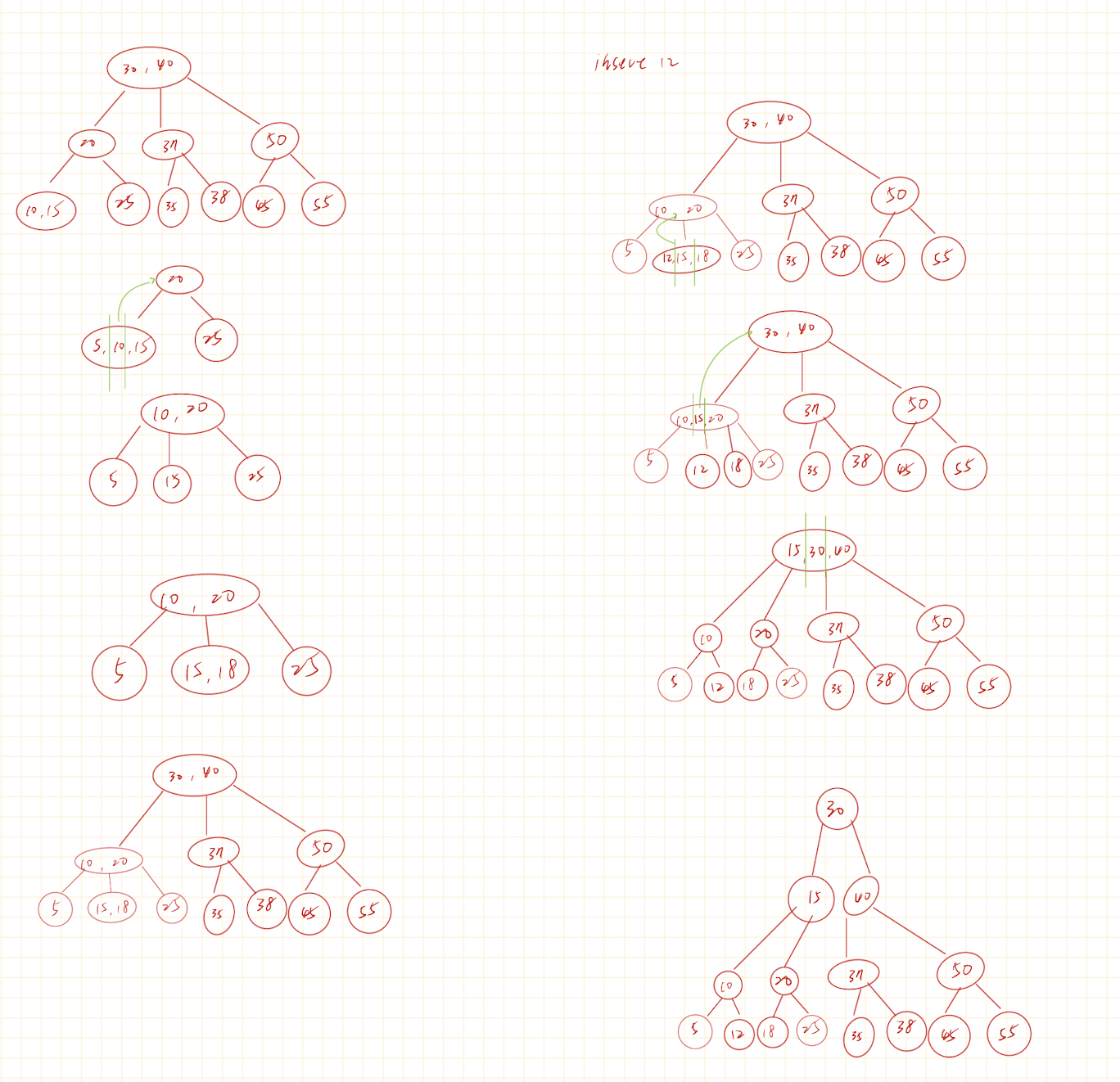
- Insert 5,18 and 12 in the 2-3 tree
Delete X in B-Tree of order m
目標:刪除鍵值 xx。先搜尋到包含 xx 的節點 NN。
-
Case I|$N$ 是 leaf
-
刪除:在 $N$ 直接移除 $x$。t6
-
檢查是否 underflow(鍵數是否太少)。
-
Not underflow:若 $|N| \ge \lceil m/2\rceil - 1$ → 完成。
-
Underflow:若 $|N| < \lceil m/2\rceil - 1$ → 進行修復:
-
Rotation(借鍵):
-
嘗試向兄弟節點(相鄰的左或右)借一鍵;
-
透過父節點分隔鍵旋轉;
-
若成功 → 完成。
-
-
Combine / Merge(合併):
-
若無法旋轉,與相鄰兄弟合併,並把父節點中的分隔鍵下移到合併後的新節點;
-
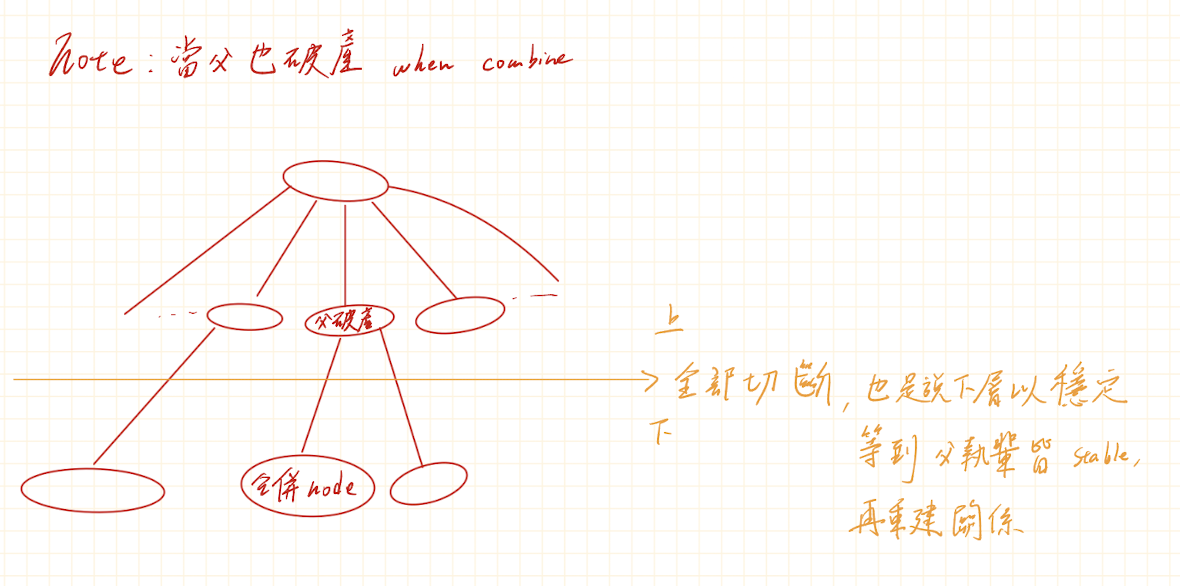
令 $N \leftarrow$ 該父節點(父節點少了一鍵),回到本 Case 的步驟 2 續檢查(可能向上連鎖)。
-
-
-
-
-
Case II|$N$ 是 non-leaf
-
選替代鍵 $y$:
-
取 前驅(左子樹中的最大鍵),或
-
取 後繼(右子樹中的最小鍵)。
-
-
交換並遞迴刪除:
-
用 $y$ 取代 $x$(位置在 $N$)。
-
到 $y$ 所在的 leaf 刪除 $y$。該 leaf 的鍵數減一,
-
因此回到 Case I 的 underflow 檢查與修復流程。
-
-
註記
-
$\lceil m/2\rceil - 1$ 為非根節點允許的最少鍵數。
-
Rotation 與 Merge 的選擇依鄰接兄弟是否有多於最小鍵數而定。
-
可能需一路向上修復直到根;若根空了且只有一個子樹,則將該子樹提升為新根。
Example
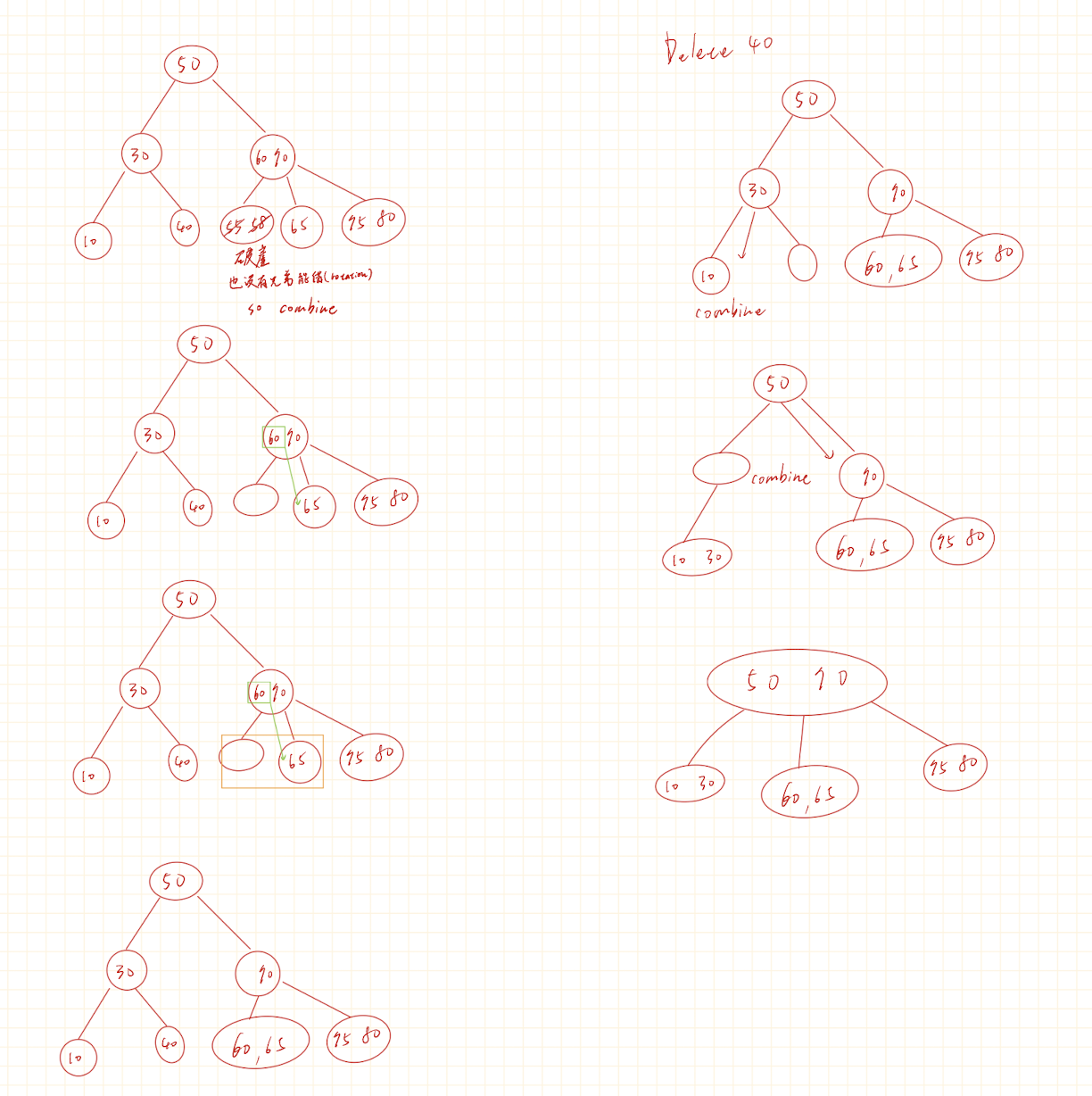
- B-Tree Order 3, delete 58 55 and 40
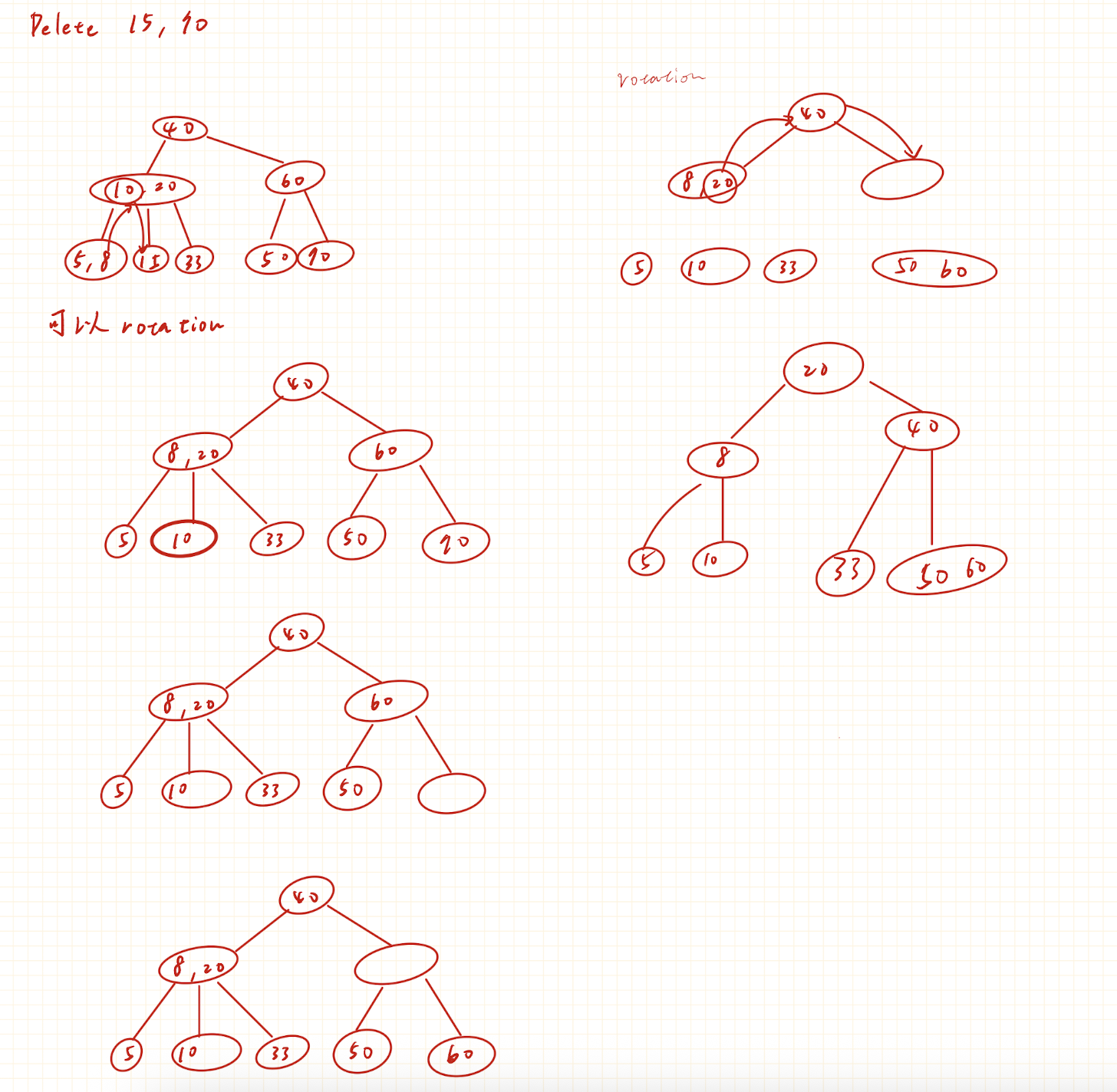
- Delete 15,70
$B^+$ Tree of order m
定義 (Definition)
-
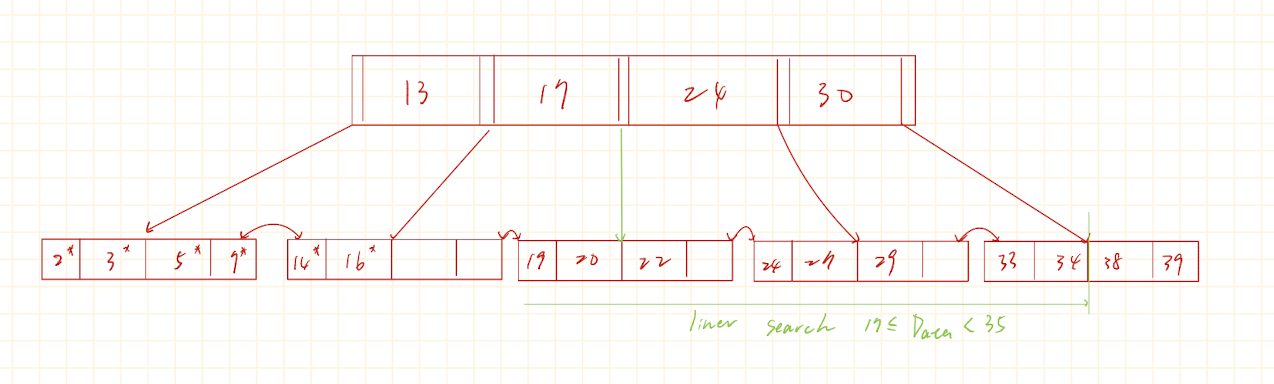
用途:ISAM(Index Sequential Access Method)。
-
僅分 兩大層:Index level、Data blocks level。
-
Index level
-
結構:B-tree of order mm。
-
功能:純索引,不放資料(只放 key 與子指標)。
-
-
Data blocks level
-
作用:存放資料(records)。
-
連結:各 data block 以 linked list 串接,方便順序讀取。
-
容量:每個 block 的資料數 可依題目/規格自行訂,不必與 index 的 order m 相同,==但是題目沒有特別說就是一樣==。
-
-
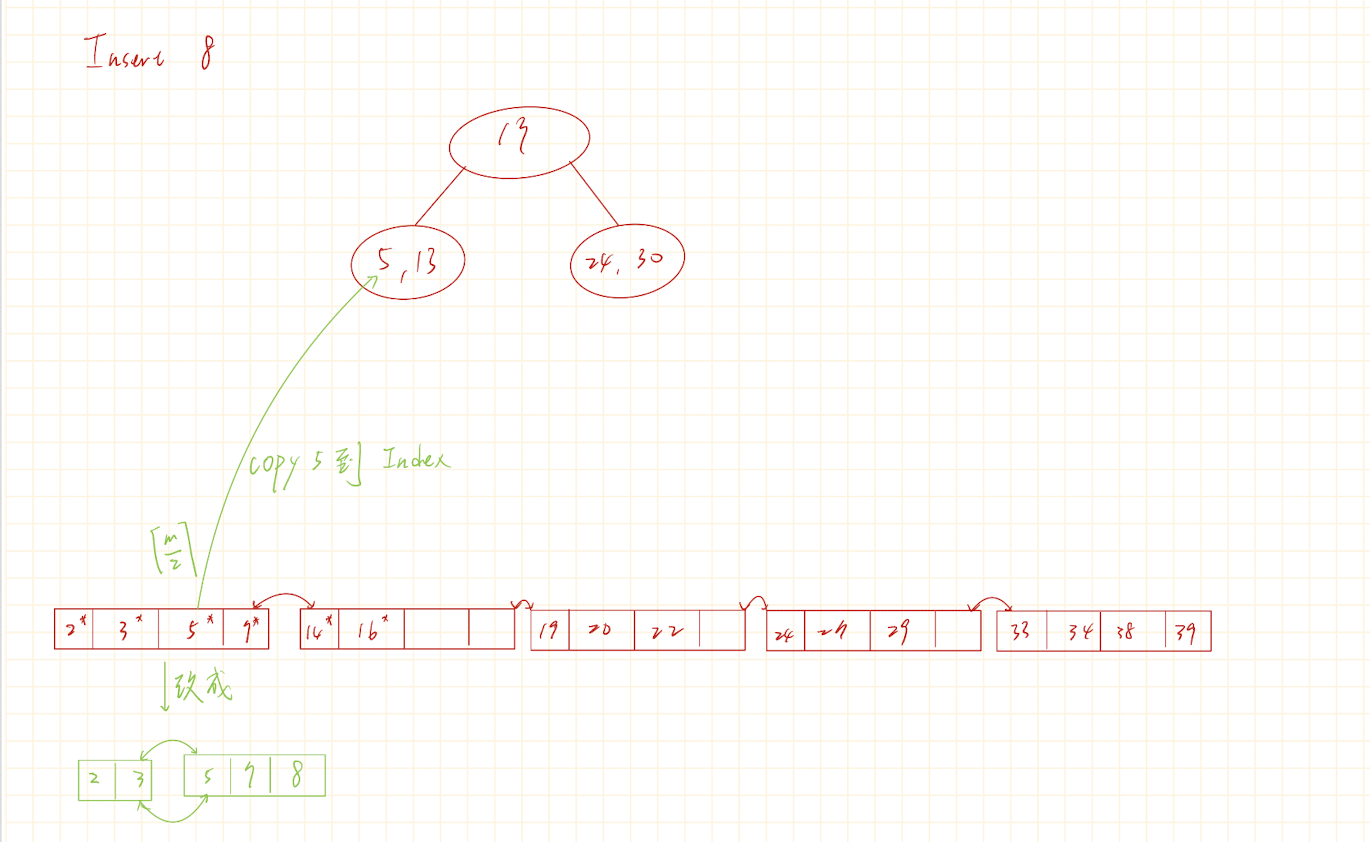
Insert a data
Delete a data
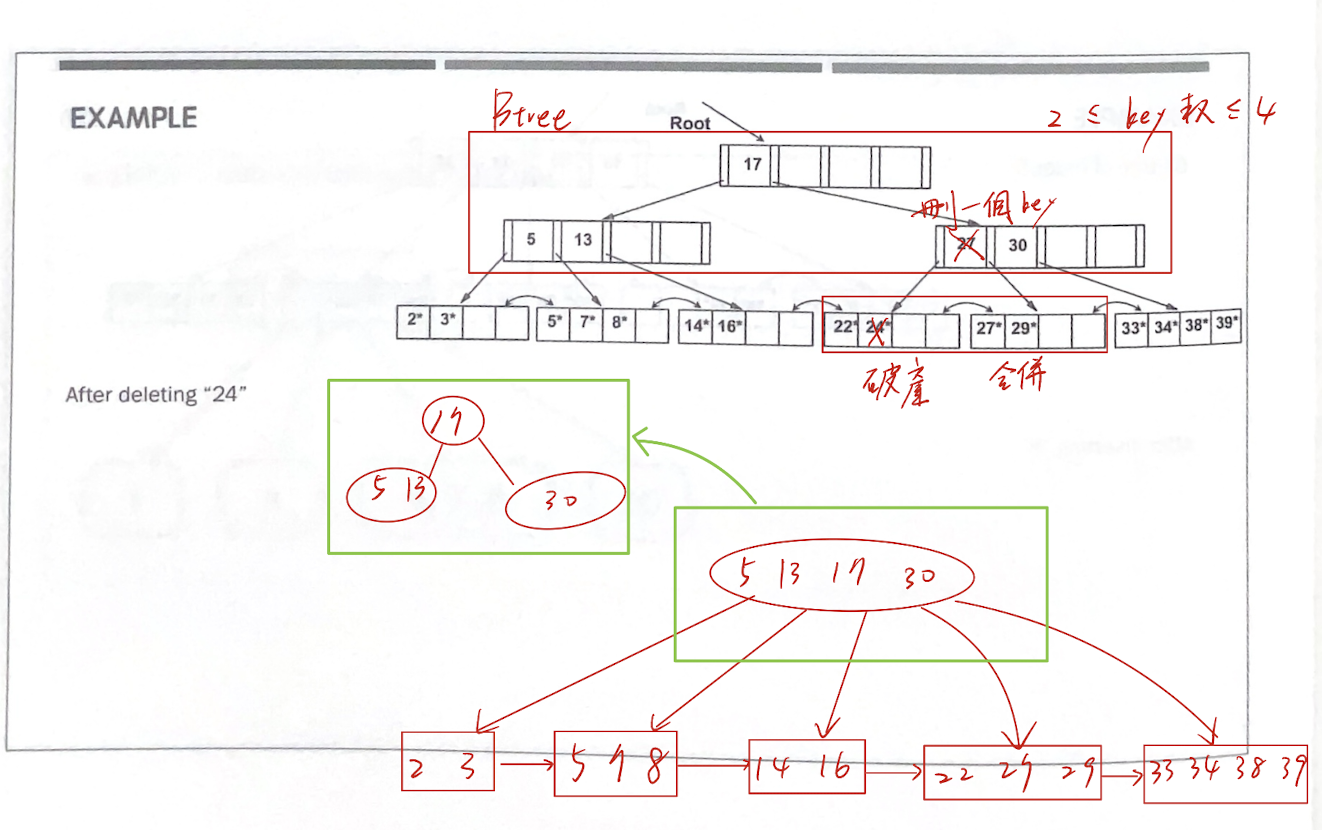
-
尋找要刪除的節點,例如刪除 24 → 在葉節點
[22 | 24]中找到。 -
從葉節點刪除 24 → 節點剩下
[22]。 -
檢查節點鍵值數,規則為 2 ≤ key ≤ 4。此時只有 1 個 key,不足。
-
嘗試向兄弟節點借 key,如果兄弟節點也不足,則進行合併。
-
[22]與兄弟節點[27 | 29]合併 → 得到[22 | 27 | 29]。 -
父節點 index 需要更新,原本有
[17 | 27 | 30],因為合併,27 作為 index 不再需要 → 父節點變為[17 | 30]。 -
再檢查父節點是否滿足 2 ≤ key ≤ 4,如果不足則繼續合併或往上更新。
-
若 root 最後只剩一個子節點,則降低樹高,新的 root 成為唯一的子節點。